


The Entry-Level Hiring Slowdown Is Starting to Show Up in Real Data
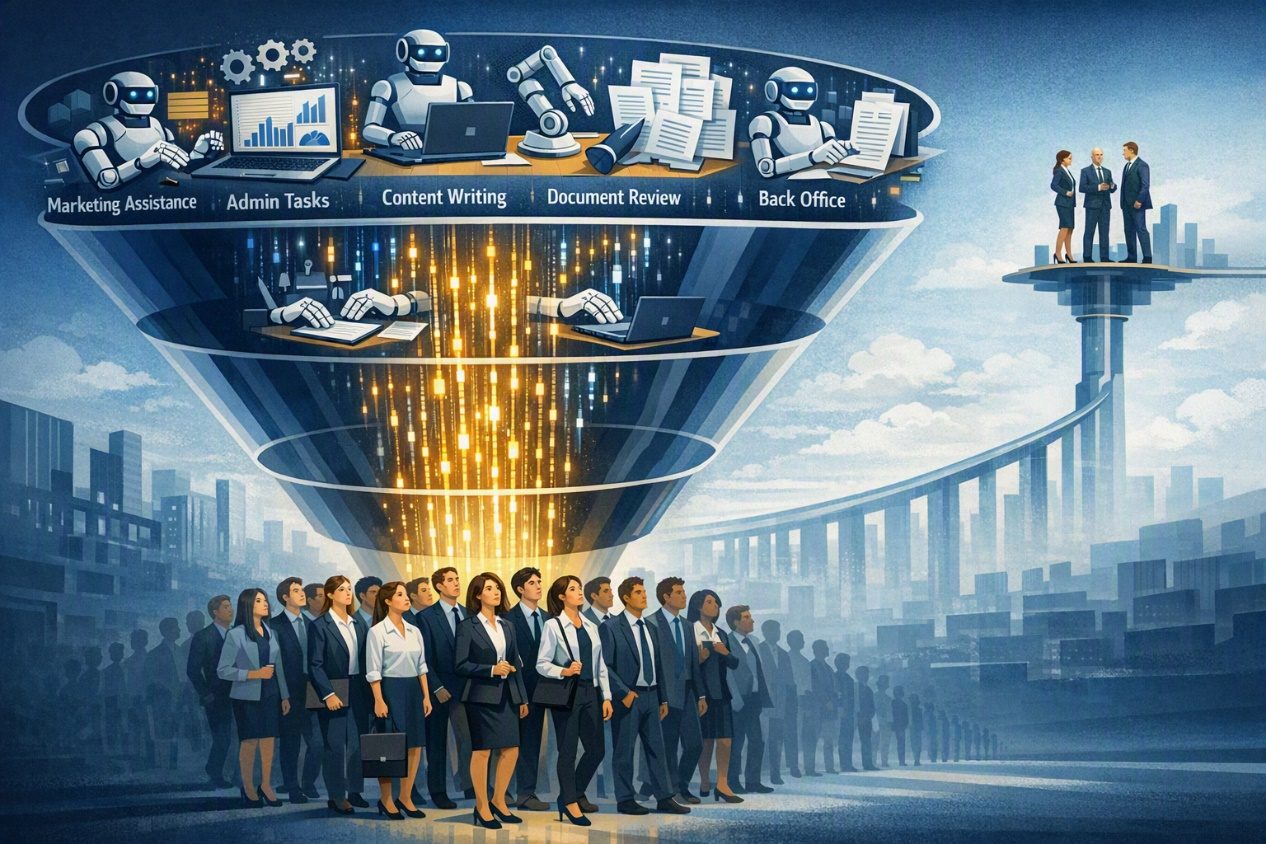
On June 24, 2026, Reuters reported on a Swiss jobs.ch study showing that entry-level hiring is beginning to weaken in the places where AI can perform part of the basic work. The study reviewed more than 7.3 million job advertisements and found that the share of entry-level roles advertised in Switzerland was 32% lower in 2025 than the average between 2019 and 2022, a period the study treated as the pre-AI baseline. Marketing, administration, finance, and IT were among the areas most affected.
This is the first kind of signal business leaders should take seriously because it is not a theoretical debate about whether AI may affect junior work someday. It is an observed change in hiring demand. The roles most exposed are not necessarily full professions. They are the early-career tasks that traditionally gave people their first commercial experience: drafting, checking, summarizing, preparing reports, collecting information, formatting documents, reconciling data, and supporting senior employees.
The short-term saving from not hiring juniors can become the long-term cost of having no experienced people later.
Where the Savings May Appear First
For mid-sized businesses, the temptation is understandable. If AI can produce a first draft, summarize a spreadsheet, prepare a marketing brief, classify customer requests, or review a document, managers may decide to delay hiring a junior employee. In the short term, that can look efficient. Payroll is lower, senior employees get AI assistance, and repetitive work moves faster.
The Talent Pipeline Problem
Every business depends on a hidden pipeline. Junior employees become experienced employees because someone gives them imperfect first work, supervises it, corrects it, and lets them build judgment over time. If companies stop hiring juniors because AI can do the basic tasks, they may later discover that no one has learned the business from the ground up.
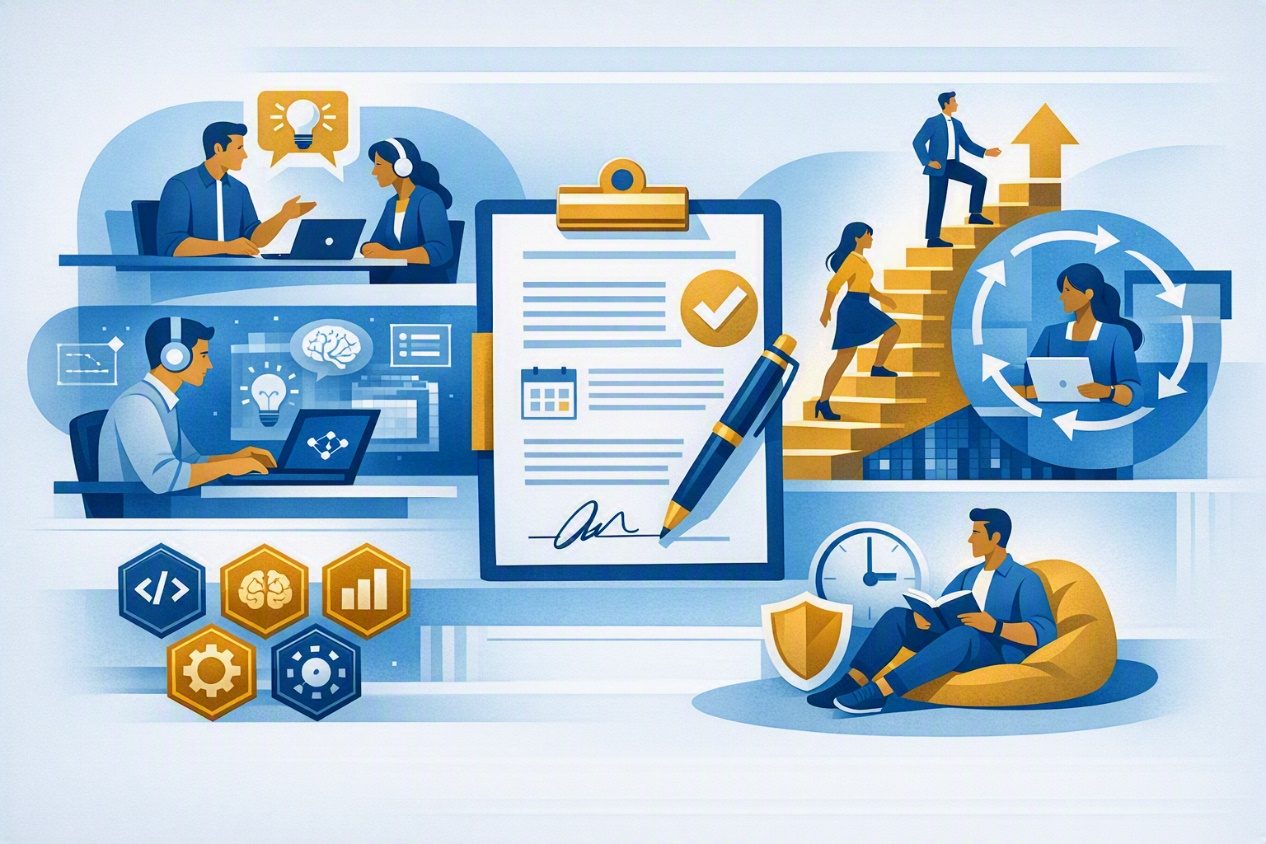
The risk is not only future recruitment difficulty. It is cultural. A company that becomes too senior-heavy may lose the energy, curiosity, adaptability, and digital fluency that younger workers bring. It may also lose loyalty. If early-career talent cannot see a path to meaningful work, training, promotion, and responsibility, they will move to employers that can offer a clearer development contract.
If AI removes the old training tasks, what new pathway will turn beginners into experienced employees?
How to Hire Juniors When AI Reduces Their Immediate ROI
The answer is not to hire juniors exactly as before and pretend AI has changed nothing. It is to redesign the junior role. Entry-level employees should no longer be used only as low-cost labor for repetitive work. They should be hired into structured learning systems where AI handles some basic production, while the employee learns judgment, customer context, process ownership, and business decision-making.
That means the company must make the value proposition explicit. A junior employee may be less profitable in the first year, especially if AI can complete part of the work faster. But if the business treats that employee as a long-term capability investment, the economics change. The goal is not to compare a junior worker against AI on a single task. The goal is to develop a future employee who can combine AI fluency with company knowledge, client understanding, and professional judgment.
A practical approach is to make junior hiring more contractual, transparent, and developmental. Instead of saying “join us and do whatever is needed,” the company can define a two- or three-year path: first master the tools, then own repeatable workflows, then support customer or management decisions, then lead a small process area. This gives young employees a reason to stay, and it gives the business confidence that today’s training cost becomes tomorrow’s capability.
The strongest junior roles will not compete against AI. They will use AI as the training environment. A junior analyst should learn how to question AI-generated insights. A marketing assistant should learn how to improve AI drafts with brand judgment. A document reviewer should learn how to verify AI issue-spotting against source material. The human skill becomes supervision, context, escalation, and decision quality.
DNLA Playbook for Junior Hiring in the AI Age
- Redesign the role, not only the salary. Define what the junior employee will learn beyond tasks AI can already perform.
- Create a visible progression path. Show the employee what skills, responsibilities, salary steps, and titles are available over two or three years.
- Use AI as a supervised training tool. Let juniors work with approved AI systems, but require review, explanation, and correction by senior staff.
- Assign mentors with accountability. Senior employees should be measured partly on developing junior talent, not only on their own output.
- Protect early-career learning time. Schedule training, feedback, and reflection instead of filling every hour with production work.
- Reward retention and capability growth. Use bonuses, certifications, internal mobility, and promotion triggers to keep young talent from leaving after the company trains them.
DNLA Take
The decline in entry-level hiring is one of the most important early labor-market signals of the AI era. For businesses, the short-term logic is clear: if AI can absorb basic work, fewer junior hires may look efficient. But companies that cut too deeply into the bottom of the talent pyramid may weaken their own future. The next generation of experienced employees has to come from somewhere. The smart response is not nostalgia for old junior roles, and not blind replacement with AI. The smart response is a new apprenticeship model: juniors who learn with AI, are supervised by humans, progress through clear pathways, and become the AI-fluent managers, analysts, operators, and advisors the business will need next.
Want the same rigor applied to your own AI system?
That's what a QAi Health Check is for.