


OpenAI Builds a Partner Network to Turn AI from Software into Implementation

On June 14, 2026, OpenAI announced the OpenAI Partner Network, a formal global program designed to help companies move from AI ambition to operational results. The company said it is investing $150 million to support an ecosystem of partners that can build, sell, integrate, deploy, and train around OpenAI technology. The target is unusually aggressive: 300,000 certified consultants by the end of 2026.
The announcement is important because it says something OpenAI could have avoided saying: enterprise AI value is no longer limited mainly by model capability. The harder bottleneck is implementation. Companies need to identify use cases, redesign workflows, connect models to existing systems and data, manage permissions, govern risk, train employees, and measure business outcomes. In other words, the next phase of AI adoption is not only about buying access to a model. It is about making the model work inside the messy reality of an organization.
The AI race is moving from who has the best model to who can make the model useful inside a real business.
Why OpenAI Needs a Partner Network
Large organizations rarely adopt technology just because the product is impressive. They need operating models, procurement paths, security reviews, data architecture, governance controls, integration with systems of record, training plans, and executive sponsorship. That is why enterprise software has historically scaled through partner ecosystems. Microsoft, Salesforce, SAP, ServiceNow, AWS, and Google Cloud all became more powerful because consultants and integrators learned how to package their platforms into repeatable business outcomes.
OpenAI is now making the same transition. A frontier model can demonstrate intelligence in a product demo, but an enterprise deployment has to survive bad data, legacy systems, unclear ownership, employee resistance, compliance questions, and unclear ROI. Partners fill that gap. They know the customer environment, the industry process, the implementation politics, and the change-management work required to move from experiment to routine use.
The Bottleneck Has Moved
For the last two years, many businesses treated AI as a technology question: which model is best, which chatbot should we buy, which license should we test, and which vendor has the strongest benchmark? Those questions still matter, but they are no longer enough. The bigger question is whether the organization can turn AI into measurable workflow improvement.
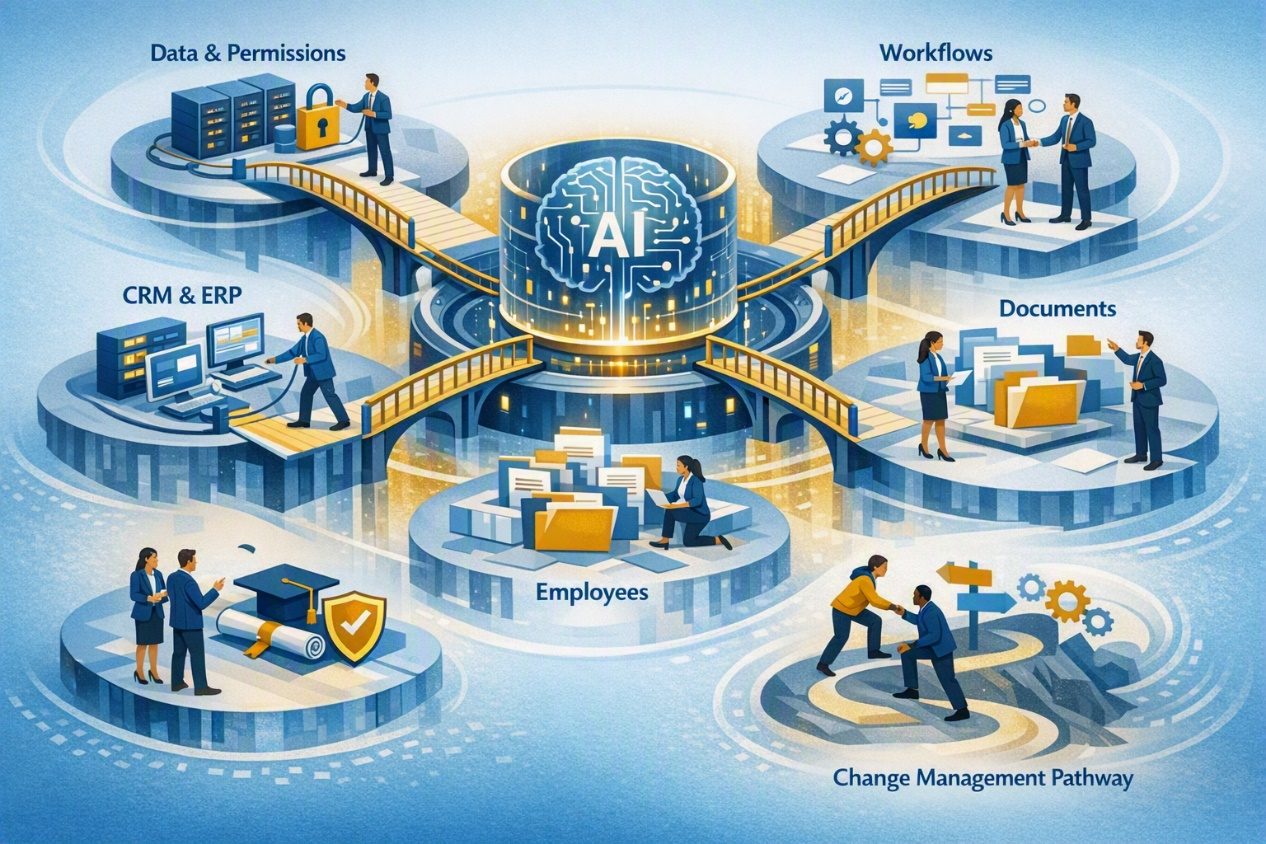
A useful AI deployment has to answer concrete operational questions. Which employee is allowed to access which knowledge source? Which data can be used in prompts? Which system should the agent update? Who approves actions? What happens when the model is uncertain? How is output reviewed? How are mistakes corrected? How does the company prove that AI created value rather than just activity?
Are we waiting for AI to become easier, or are competitors already using partners to make it operational?
Why Slow Movers May Fall Behind
The OpenAI Partner Network lowers the barrier to enterprise adoption. A business that previously lacked internal AI expertise may soon be able to call an integrator, consultant, or training partner with a certified delivery path. That does not guarantee success, but it changes the competitive timeline. AI is becoming easier to access, easier to deploy, and easier to connect with serious implementation support.
That creates a warning for companies dragging their feet. A firm that postpones AI adoption because the tools feel immature may discover that competitors are using certified partners to automate reporting, accelerate service, improve sales preparation, reduce administrative load, support procurement, analyze documents, and redesign customer workflows. The gap may not appear all at once. It may show up as faster response times, lower cost per task, better employee leverage, and more disciplined use of company knowledge.
DNLA Playbook for Businesses
- Do not start with tools. Start with workflows where time, cost, quality, or customer experience can improve.
- Identify the integration gap. Map which systems, files, permissions, and data sources AI would need to access safely.
- Choose partners by outcome. Prefer partners who can show business impact, governance maturity, and change-management capability.
- Train managers, not only users. AI adoption fails when leaders cannot redesign work or measure results.
- Create a 90-day deployment target. Pick one clear use case, define a baseline, pilot with a partner, and measure before scaling.
- Watch the competitive gap. If competitors are already using AI to reduce cycle time, waiting becomes a strategic risk.
DNLA Take
OpenAI’s Partner Network is a signal that the AI market is entering its implementation phase. The frontier model is still important, but the scarce capability is shifting toward deployment: connecting AI to data, workflows, permissions, business processes, and people. For large consultancies and integrators, this is a new services economy. For mid-sized businesses, it is both an opportunity and a warning. The opportunity is access to AI expertise without building everything internally. The warning is that the excuse of waiting may disappear. If the ecosystem makes adoption easier and competitors move first, the cost of hesitation will rise. In the next stage of AI, the winners will not simply have access to powerful models. They will know how to put them to work.
Want the same rigor applied to your own AI system?
That's what a QAi Health Check is for.