


The AI Investment Wave Is Creating Opportunities for “Boring” Businesses
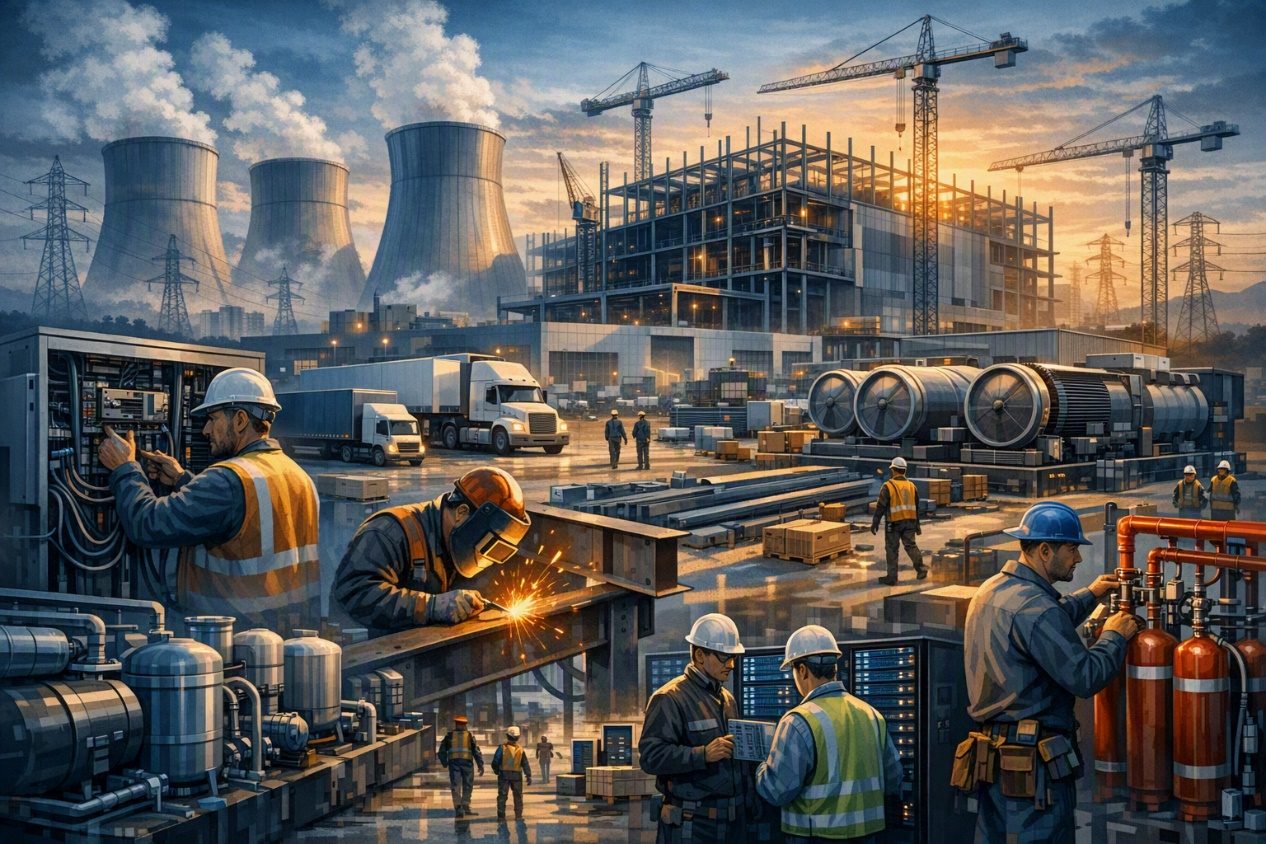
Most headlines about AI investment focus on the companies building models. But in July 2026, the physical side of the AI economy became harder to ignore. Data centers, semiconductor fabs, high-density power systems, liquid cooling, grid upgrades, substations, transformers, water infrastructure, logistics, and maintenance crews are all becoming part of the AI story. The opportunity is not only in software. It is also in concrete, copper, cooling, cranes, compliance, and skilled labor.
Research from Cushman & Wakefield shows that businesses tied to the data center ecosystem accounted for 10.4% of new industrial leasing activity across six major U.S. data center markets between 2022 and 2025, rising to a record 14.4% in 2025 as data center-related leasing grew 44% year over year. The firm’s report highlights demand from electrical equipment manufacturers, cooling systems, power infrastructure providers, engineering firms, telecommunications companies, logistics providers, wholesalers, and specialized contractors.
AI may be digital, but the buildout is physical. The next winners may sell power, cooling, safety, water, logistics, and maintenance.
Why the Opportunity Looks “Boring”
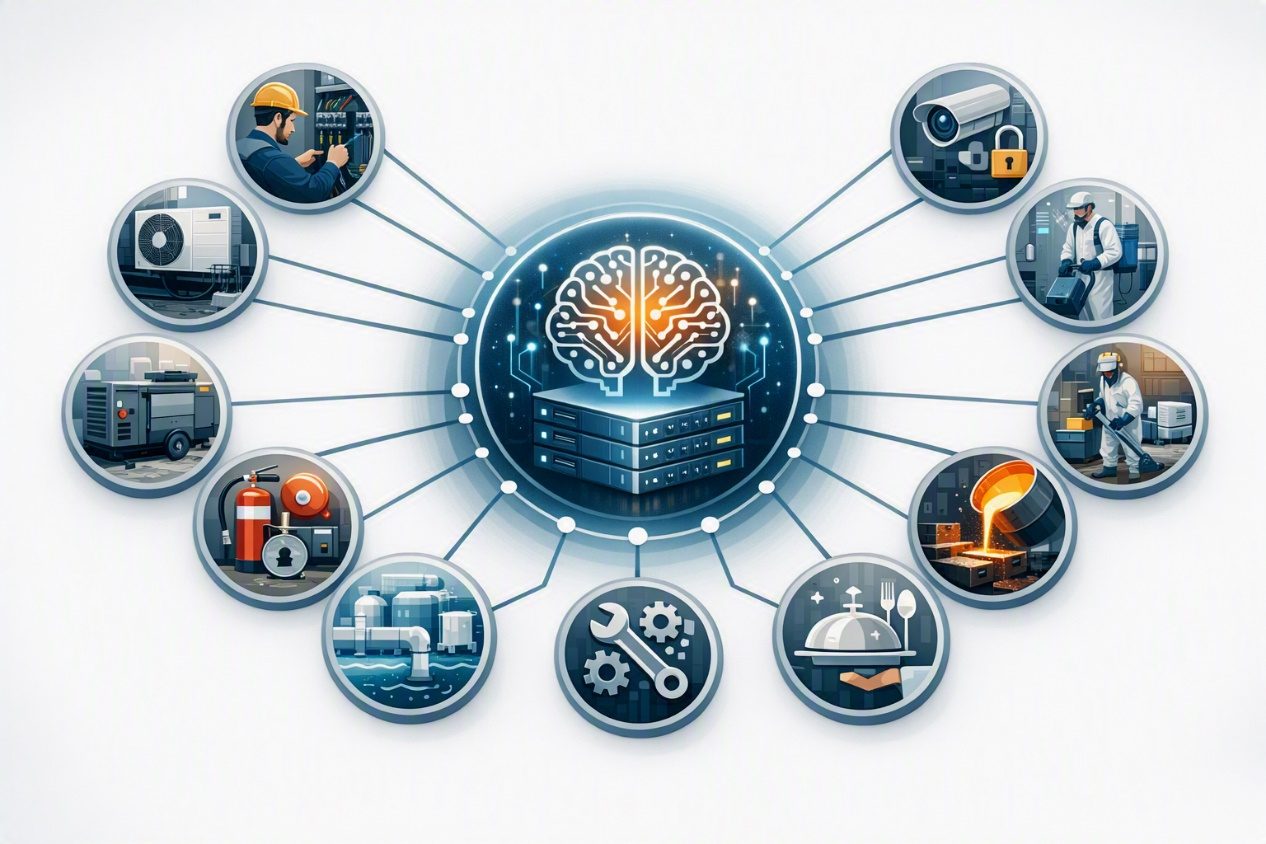
The most valuable business opportunities are not always glamorous. A hyperscale AI campus needs advanced chips, but it also needs electrical contractors, switchgear, backup generators, cooling systems, fire suppression, physical security, industrial cleaning, heavy transport, metals, concrete, building maintenance, water treatment, food services, and technicians who can keep critical facilities running. These categories rarely appear in consumer AI demos, but no large-scale AI deployment works without them.
McKinsey estimates that global spending on data centers could reach $7 trillion by 2030 and argues that industrial suppliers of electrical, thermal, and mechanical equipment are central to the buildout. The constraint is not only capital; it is execution. Data centers require long-lead components such as transformers, switchgear, thermal systems, power distribution equipment, and mechanical infrastructure. When demand accelerates faster than traditional industrial supply chains can respond, room opens for new suppliers, adjacent manufacturers, and service firms that can meet the speed, quality, and reliability requirements of AI infrastructure.
The Manufacturing Signal
The U.S. manufacturing story also reflects this shift. IndustrySelect’s July 2026 roundup of new U.S. factories noted an AI infrastructure manufacturing wave that included Bosch bringing silicon carbide semiconductor production online in California, Foxlink launching its first U.S. AI Factory, Flex scaling production of an advanced AI computing system in Silicon Valley, and a major manufacturer breaking ground on what is expected to become the nation’s largest facility for large power transformers. Semiconductor expansion is also feeding the same ecosystem, with Micron announcing that it raised planned U.S. investments to more than $250 billion through 2035 and celebrated the first concrete pour at its Clay, New York fab site.
For a manufacturer, contractor, or regional service provider, the opportunity may not be to “add AI” to the product. It may be to become AI-infrastructure-ready: faster quoting, stronger documentation, better compliance, 24/7 service windows, specialized safety training, secure facility access, digital maintenance records, and the ability to work with large customers that operate on strict uptime expectations.
Can your company become a trusted supplier to the physical AI economy, even if you do not sell an AI product?
How “Boring” Businesses Can Reposition
- Translate the offer into infrastructure language. Replace generic descriptions with data-center-relevant promises: uptime, redundancy, safety, response time, documentation, and compliance.
- Build proof for large buyers. Prepare case studies, certifications, insurance documentation, safety records, audited procedures, and references.
- Adapt to compressed timelines. AI infrastructure customers often need faster deployment than traditional industrial projects. Suppliers that can quote, schedule, and deliver quickly gain an advantage.
- Partner across the stack. Electrical, cooling, fire, security, water, logistics, and maintenance providers can form bundled offerings for data center developers and semiconductor projects.
- Invest in workforce readiness. Skilled technicians, safety training, background checks, and secure-site protocols may become as important as price.
Risks Hidden in the Boom
Not every supplier should chase every AI infrastructure project. The same boom that creates opportunity also brings concentration risk, customer power, payment complexity, labor shortages, long sales cycles, and demanding service-level requirements. Data center projects can be delayed by power interconnection, permitting, community opposition, water availability, or supply-chain bottlenecks. A small supplier that expands too quickly for one large project can create financial risk if construction timelines slip.
That is why the best strategy is disciplined specialization. A company should identify where its existing capabilities intersect with the infrastructure buildout, then improve the parts that matter to serious buyers: reliability, compliance, documentation, safety, capacity, and repeatability. The goal is not to sound like a tech company. The goal is to look like a dependable infrastructure partner.
DNLA Playbook for Industrial and Service Providers
- Map your relevance. List the ways your current products or services support data centers, fabs, energy infrastructure, or mission-critical facilities.
- Package for critical operations. Create service bundles around uptime, emergency response, preventive maintenance, and compliance documentation.
- Upgrade buyer materials. Prepare technical sheets, safety policies, certifications, response-time commitments, and project references.
- Find ecosystem partners. Join with complementary suppliers so large buyers can source more complete solutions.
- Protect the core business. Avoid overcommitting capacity to speculative projects or one dominant customer.
- Measure margin, not hype. Track whether AI infrastructure work improves profitability after labor, insurance, financing, and service requirements.
DNLA Take
The AI economy is not only a story of models, chips, and cloud platforms. It is also a story of electricians, cooling engineers, steel suppliers, cleaning crews, water systems, security teams, caterers, logistics firms, and maintenance technicians. For many mid-sized businesses, the best AI opportunity may not be building an AI product. It may be serving the companies that build the infrastructure AI cannot live without. In this cycle, “boring” may be exactly where the money is.
Want the same rigor applied to your own AI system?
That's what a QAi Health Check is for.