


Law and Accounting Firms Need to Sell Accountability, Not Document-Preparation Hours

The professional-services business model is entering its most uncomfortable AI phase. According to the 2026 AI in Professional Services Report from Thomson Reuters, AI is no longer just an experiment in legal, tax, accounting, audit, compliance, risk, fraud, and government work. Generative AI use has nearly doubled, around 40% of professionals say their organizations now use it, and more than 80% of current users engage with it weekly.
The report describes 2026 as the strategic phase of AI: a moment when firms are not only adding tools, but redefining workflows, reshaping value, and building AI into the foundation of professional work. That is a powerful opportunity for firms that move early. It is also a warning for firms still selling manual drafting and research effort as if clients cannot see the clock changing.
When AI compresses the first draft, the client stops paying for typing, and starts paying for judgment.
Which Tasks Are Losing Their Premium?
AI does not make legal, accounting, tax, or audit expertise disappear. But it does reduce the perceived value of routine intermediate work: document summaries, first drafts, contract comparisons, initial research, letters, invoice classification, checklist preparation, and basic anomaly detection. These tasks still require review, but they no longer look like five hours of scarce expert labor to a client who knows that AI can produce a useful first pass in minutes.
The Client’s New Question
Business clients are increasingly aware that AI can draft, summarize, classify, and compare. That does not mean they want unreviewed AI output. It means they will challenge invoices that appear to charge premium rates for work that looks machine-assisted. A client may accept paying for responsibility, sign-off, escalation, negotiation, representation, and risk management. The harder conversation is paying five billable hours for a draft that was prepared in thirty minutes and lightly edited afterward.
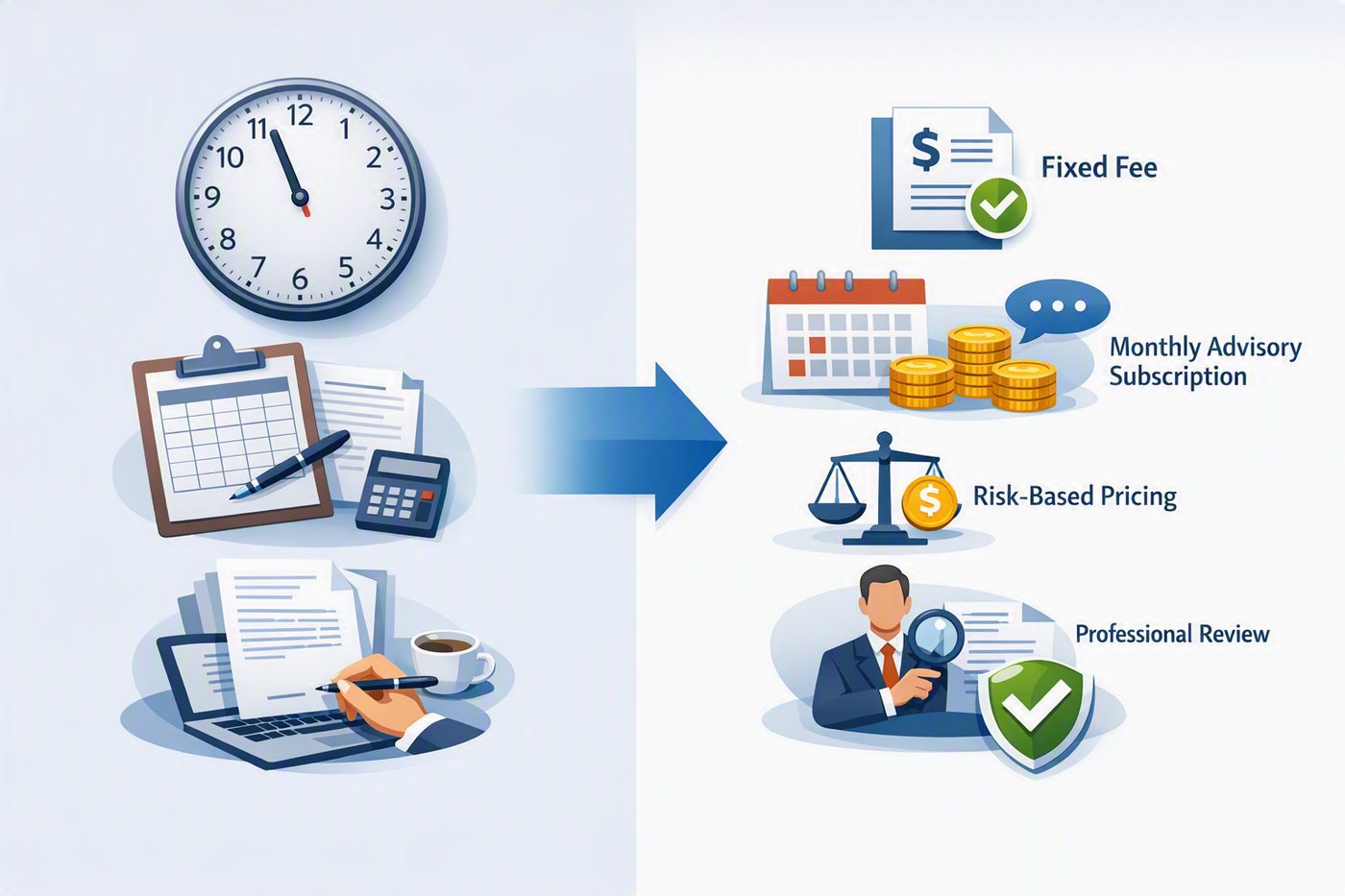
Are we paying for hours spent, or for risk reduced?
From Billable Hours to Value Structures
The traditional billable-hour model does not disappear overnight. Complex matters, uncertain litigation, sensitive transactions, and open-ended investigations still require flexible pricing. But the center of gravity can shift. When AI reduces the time required for repeatable work, firms need pricing models that connect fees to outcomes, assurance, availability, and complexity rather than keyboard time.
- Fixed price per outcome: a defined fee for a reviewed contract package, tax position memo, compliance filing, or audit deliverable.
- Monthly advisory subscription: access to ongoing review, guidance, and escalation for recurring operational questions.
- Continuous support model: embedded counsel, controllership, compliance, or risk advisory available as part of business operations.
- Professional review fee: clients generate or collect materials, while the firm charges for validation, correction, and responsibility.
- Risk- and complexity-based pricing: matters are priced by exposure, ambiguity, urgency, jurisdictional complexity, and professional liability.
The Accountability Layer
The more AI automates preparation, the more valuable the accountability layer becomes. A firm’s defensible value is not that it can produce words on a page. It is that a qualified professional knows what the words mean, what is missing, what could go wrong, and what the client should do next. In legal work, that means privilege, representation, negotiation posture, enforceability, and dispute strategy. In accounting and tax, it means substantiation, audit readiness, documentation, controls, reporting confidence, and regulatory exposure.
Thomson Reuters also highlights a measurement gap: only a minority of professional-services organizations track AI return on investment, while many professionals do not know whether ROI is measured at all. That creates a double challenge. Firms need to price differently, but they also need to measure the value AI creates internally so they do not simply discount their work while absorbing the cost of transformation.
DNLA Playbook for Law, Tax, and Accounting Firms
- Map vulnerable tasks. Identify work that is mostly summarization, drafting, comparison, classification, or checklist production.
- Separate preparation from responsibility. Price routine AI-assisted preparation differently from professional review, sign-off, and advice.
- Create transparent client language. Explain when AI may be used, how outputs are reviewed, and what professional responsibility the firm accepts.
- Build outcome packages. Convert common matters into fixed-fee or subscription offerings tied to deliverables and response times.
- Measure internal AI economics. Track time saved, write-downs avoided, margin changes, cycle time, and client satisfaction.
- Protect trust. Maintain confidentiality, data governance, privilege controls, source verification, and human accountability.
What Clients Should Ask
- Which parts of the work are AI-assisted, and which parts are reviewed by a licensed professional?
- What does the firm verify before giving advice or signing a deliverable?
- Can repeatable work be priced as a package instead of by the hour?
- How does the firm protect confidential information when AI tools are used?
- What responsibility does the firm accept for the final recommendation?
DNLA Take
AI is not eliminating the need for lawyers, accountants, auditors, or tax professionals. It is eliminating the client’s willingness to pay premium rates for routine preparation that no longer requires premium time. Firms that continue selling typing, first-pass research, and document assembly will feel pressure. Firms that sell judgment, representation, assurance, and responsibility will remain essential. The business model must move from “how long did this take?” to “what risk did we control, what outcome did we deliver, and who stands behind it?”
Want the same rigor applied to your own AI system?
That's what a QAi Health Check is for.