


GPT-Live Turns Voice from Turn-Taking into Continuous Presence

OpenAI’s GPT-Live launch on July 8, 2026 may look like a voice-interface upgrade, but the deeper shift is architectural. GPT-Live is a new family of voice models built on a full-duplex design, meaning the system can listen and speak at the same time. Instead of waiting for a clean pause, transcribing a recording, generating a reply, and then playing audio back, the model can keep the conversation moving while it continues to process what the user is saying.
In practice, that means a user can interrupt naturally, pause to think without being cut off, and hear small acknowledgments such as “mhmm” or “yeah” while the system stays engaged. GPT-Live can also delegate harder work to a frontier model in the background for search, reasoning, or agentic tasks, then bring the answer back into the live conversation without breaking the flow.
Voice AI is moving from push-to-talk interaction to something closer to a live colleague in the room.
Why Full-Duplex Matters
Older voice systems often behaved like walkie-talkies: one side speaks, the other waits. Even when the voice sounded natural, the conversation could still feel mechanical because the system had to detect the end of a turn. A brief pause could trigger an unwanted answer. A user interruption might be ignored. Background noise could confuse the timing. GPT-Live changes the rhythm by continuously deciding whether to listen, speak, pause, interrupt, or call another tool.
This is why the launch matters for agents. A chat window is episodic: the user asks, the system answers, the user asks again. A full-duplex voice interface can become continuous: the agent listens during a task, responds during the task, watches context change, and supports the user while work is happening. Voice becomes less like dictation and more like presence.
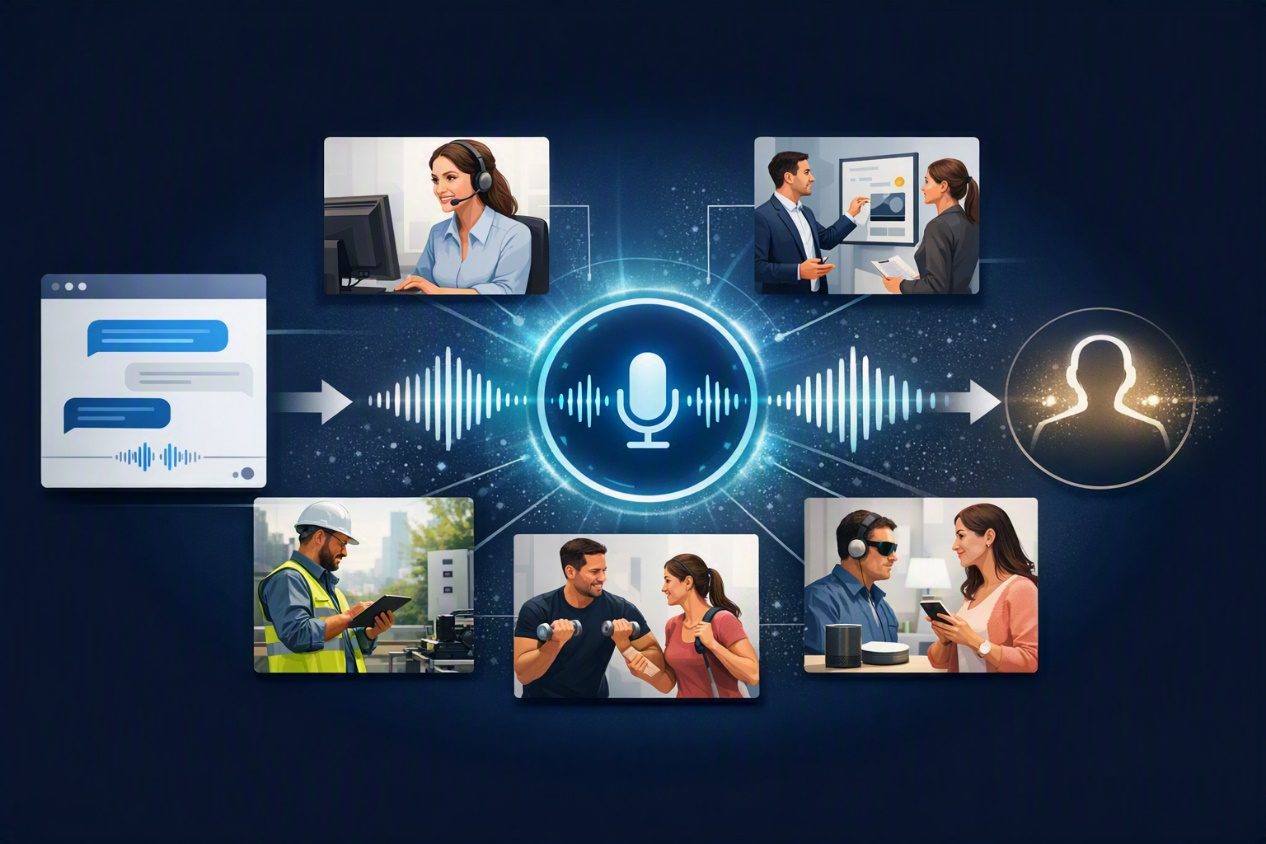
What Changes for Businesses?
Voice, Text, Images, Search, Memory, and Actions in One Flow
The most important part of the user experience is not simply that the model talks better. It is that voice becomes the front door to a multimodal agent. A user can speak, the system can search, retrieve memory, reason in the background, reference text or images, trigger tools, and present visual cards while the conversation continues. That turns voice into an operating layer rather than a decorative feature.
OpenAI’s release notes also introduced GPT Live Transcribe for low-latency streaming transcription and GPT Transcribe for file and batch transcription. For businesses, that matters because the voice stack is splitting into two practical needs: live interaction during a conversation and accurate processing of completed audio afterward. Contact centers, meeting tools, training platforms, legal intake, healthcare support, and field-service documentation may need both.
Is voice just another input method, or is it becoming the real-time command center for the workflow?
The New Risk: Always-On Expectations
Continuous voice interfaces also raise new expectations and risks. Users may assume the system is listening more broadly than it is, or expect it to remember, act, and escalate with human-like reliability. Businesses must decide when the agent may take action, when it must ask for confirmation, when the conversation should be transcribed, how long audio-derived data is retained, and how users are informed that AI-generated voice or audio may be involved.
OpenAI has also added provenance measures for supported GPT-Live audio, including SynthID watermarking and verification capabilities. That direction is important for enterprises because believable voice interfaces create new trust, compliance, fraud, and disclosure questions. The more natural the system sounds, the more important it becomes to make clear what is AI, what is human, and what has been recorded or acted upon.
DNLA Playbook for Continuous Voice Agents
- Start with interruption-heavy workflows. Prioritize use cases where natural back-and-forth matters: support calls, training, field operations, and guided sales.
- Define action boundaries. Decide what the voice agent may do automatically, what requires confirmation, and what must be handed to a human.
- Design for disclosure. Make clear when users are speaking with AI, when audio is transcribed, and how data is retained.
- Measure conversation quality. Track interruption handling, successful task completion, containment rate, user satisfaction, escalation accuracy, and time to resolution.
- Combine live and batch transcription. Use live transcription for interaction and batch transcription for audit, training, search, and quality review.
- Test in noisy reality. Pilot with accents, background noise, overlapping speech, mobile connections, and long sessions before scaling.
DNLA Take
GPT-Live is not just a smoother voice mode. It is a signal that the agent interface is moving from chat windows to continuous conversational presence. For customer service, training, accessibility, operations, sales, and personal productivity, the winning experiences will not simply speak responses aloud. They will listen, reason, act, display, remember, and hand off at the right moment. The business challenge is to make that presence useful, governed, measurable, and trustworthy.
Want the same rigor applied to your own AI system?
That's what a QAi Health Check is for.