


Measuring AI ROI Is Moving from a Luxury to an Executive Requirement

In July 2026, the conversation around AI in business became more disciplined. It is no longer enough to know that employees opened Copilot, tried a prompt, or attended an AI training session. Leadership teams now want to know what happened next: which capabilities were used, how often they were used, which departments adopted them, whether a real workflow was completed, how much time was saved, how much each interaction cost, and whether the organization created measurable business value.
This shift is showing up in the tools themselves. Microsoft describes Copilot Analytics as a way to measure readiness, adoption, productivity impact, business value, and ROI across Microsoft 365 Copilot, Copilot Chat, agents, admin reports, Viva Insights dashboards, and custom reporting. The direction is clear: AI measurement is moving from anecdotal success stories to executive-grade reporting.
If the only metric is that someone used AI, the organization is still measuring curiosity, not value.
Why ROI Measurement Became Urgent
Mid-sized companies cannot afford dozens of AI experiments with no owner, no baseline, and no economic target. A proof of concept may be exciting in a demo, but a CFO will eventually ask three questions: What changed in the business? How much did it cost? Can we repeat the result at scale?
The problem is that “time saved” is often misunderstood. If an employee saves one hour and uses that hour to close more tickets, prepare more quotes, onboard more customers, or reduce backlog, the company has gained capacity. But if the hour disappears into unmeasured slack and output does not change, the organization may not have created financial return at all. Time saved is a signal; completed work is evidence.
From Usage Analytics to Business Evidence
Modern AI analytics can show which Copilot actions employees take across Microsoft 365 apps, how usage changes over time, and where adoption is concentrated. Microsoft’s reporting model also allows organizations to combine Copilot usage data with Microsoft Graph data and, in some cases, organizational metrics from systems such as Salesforce, SAP, or Workday. That is important because the business value of AI rarely lives inside the AI tool alone. It lives in the process that the AI improves.
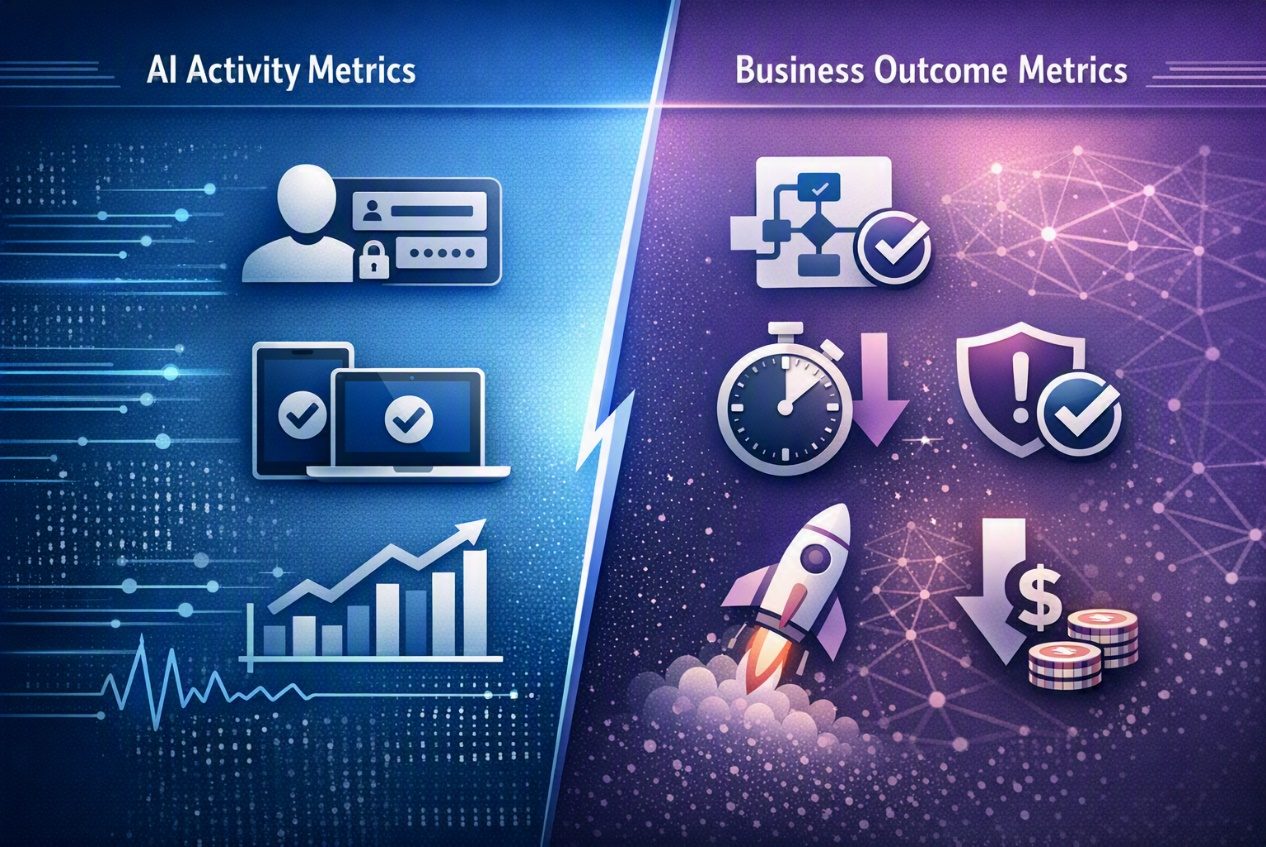
For example, Copilot may help a service representative summarize a customer history faster. That matters only if it reduces average handling time, improves first-contact resolution, lowers escalation volume, or raises customer satisfaction. Copilot may help a salesperson draft a proposal faster. That matters only if quote turnaround improves, win rate increases, or sales capacity expands. Copilot may help HR prepare onboarding material faster. That matters only if new employees become productive sooner or HR reduces repetitive administrative work.
Can the AI metric be connected to a process owner, a baseline, and a financial or operational target?
Metrics That Matter More Than “Hours Saved”
- Order processing time: the time from order entry to confirmation, fulfillment handoff, or invoicing.
- Service ticket resolution time: the time required to close a customer issue, not just draft a response.
- First-contact resolution rate: whether AI-assisted employees solve more issues without escalation.
- Reports per analyst: whether analysts produce more usable reports, dashboards, or insights in the same period.
- Quote preparation time: the time from customer request to approved commercial proposal.
- Error rate: reduction in mistakes, rework, compliance gaps, or inconsistent outputs.
- Employee onboarding time: how quickly a new employee reaches productive performance.
- Cost per completed document or action: the fully loaded cost of producing an output, including licenses, labor, review, and rework.
The DNLA ROI Ladder
- Activity: employees open the tool, submit prompts, or use AI features.
- Adoption: usage becomes regular, role-specific, and visible across departments.
- Productivity: users complete defined tasks faster or with less manual effort.
- Process impact: cycle time, error rate, throughput, service quality, or onboarding speed improves.
- Financial return: the organization reduces cost, increases capacity, improves revenue, or avoids measurable risk.
The danger is stopping at the first two levels. Activity and adoption are necessary, but they do not prove ROI. They only prove that the tool reached people. Real value begins when AI changes a business process and the organization can show the before-and-after comparison.
A Simple 90-Day Measurement Plan
Days 1–15: define the use case. Choose one process with volume, clear ownership, and visible pain. Examples include quote generation, service ticket triage, onboarding documentation, monthly reporting, or contract review preparation. Capture the current baseline: time, cost, error rate, backlog, and quality.
Days 16–45: run the pilot. Assign AI licenses to the users closest to the workflow. Train them on the specific process, not generic prompting. Track usage by department, feature, frequency, and outcome. Do not move licenses too quickly; AI habits need time to form.
Days 46–75: compare results. Measure whether the process changed. Did orders move faster? Did support tickets close sooner? Did analysts complete more reports? Did error rates fall? Did onboarding shorten? If the answer is only “people used AI,” the pilot is not finished.
Days 76–90: decide whether to scale. Expand only if the pilot shows measurable operational value, not because the tool is popular. If the result is promising but unclear, refine the workflow and repeat. If there is no change in output, reassign licenses to a higher-value use case.
DNLA Take
AI ROI measurement is becoming a management discipline. The new question is not whether a company has AI, and not even whether employees are using it. The question is whether AI is changing the economics of work. For mid-sized businesses, the most valuable AI dashboard will not be the one with the most colorful usage charts. It will be the one that shows which workflows became faster, cheaper, safer, or more scalable, and which experiments should stop.
Want the same rigor applied to your own AI system?
That's what a QAi Health Check is for.